

Housing affordability has become one of the biggest challenges facing Americans today. Home prices remain elevated, inventory is limited in many markets, and high mortgage rates have made buying a home more difficult for millions of families.
In response, Congress passed the bipartisan 21st Century ROAD to Housing Act, a sweeping package of housing reforms designed to increase housing supply, modernize federal housing programs, and reduce barriers to new development. As of June 2026, the bill has passed both the Senate and the House and is awaiting final action by the President The act passed with surprising margins rarely seen: 358 to 32 in the House, 85 to 5 in the Senate.
While the legislation won’t solve the housing shortage overnight, it could influence the market in ways that investors should understand.
[ Thinking about investing in real estate? Register to attend a FREE online real estate class and learn how to get started investing in real estate. ]
What Is the 21st Century ROAD to Housing Act?
The 21st Century ROAD (Renewing Opportunity in the American Dream) to Housing Act combines dozens of bipartisan housing proposals into one comprehensive bill. Its primary goal is to make housing more affordable by encouraging new construction, updating federal housing programs, streamlining certain regulations, and expanding homeownership opportunities.
Among its key provisions are:
- Expanding programs that encourage new housing development
- Streamlining certain federal permitting and regulatory processes
- Supporting manufactured and workforce housing
- Modernizing HUD housing programs
- Increasing access to financing for certain homebuyers
- Limiting future purchases of single-family homes by very large institutional investors above a specified ownership threshold, while exempting many build-to-rent projects
Where Could Investors Feel the Biggest Impact?
While the 21st Century ROAD to Housing Act includes dozens of housing-related provisions, one of the most talked-about measures is aimed at large institutional investors. Under the legislation, companies that own 350 or more single-family homes would generally be prohibited from purchasing additional single-family properties, with certain exceptions, such as qualifying build-to-rent developments.
For most FortuneBuilders readers, this provision won’t directly affect how you buy or sell real estate. However, it could have an indirect impact in markets where institutional investors have been particularly active over the past decade.
In some metropolitan areas, large investment firms have competed aggressively for entry-level homes, often making cash offers that have made it more difficult for individual buyers and smaller investors to compete. If the legislation reduces future acquisitions by these large investors, independent real estate investors may find less competition when pursuing single-family investment properties in those markets.
That doesn’t mean every market will suddenly become easier to invest in. Institutional ownership is concentrated in a relatively small number of cities (ex. Atlanta, GA, Jacksonville, FL, and Charlotte, NC), so any meaningful effects are likely to be localized rather than nationwide. Investors should continue evaluating opportunities based on local inventory levels, population growth, employment trends, and neighborhood fundamentals rather than assuming federal legislation alone will reshape their market.
What Could It Mean for Investors?
For most individual investors, the legislation is unlikely to create immediate changes. However, several provisions could influence the market over time.
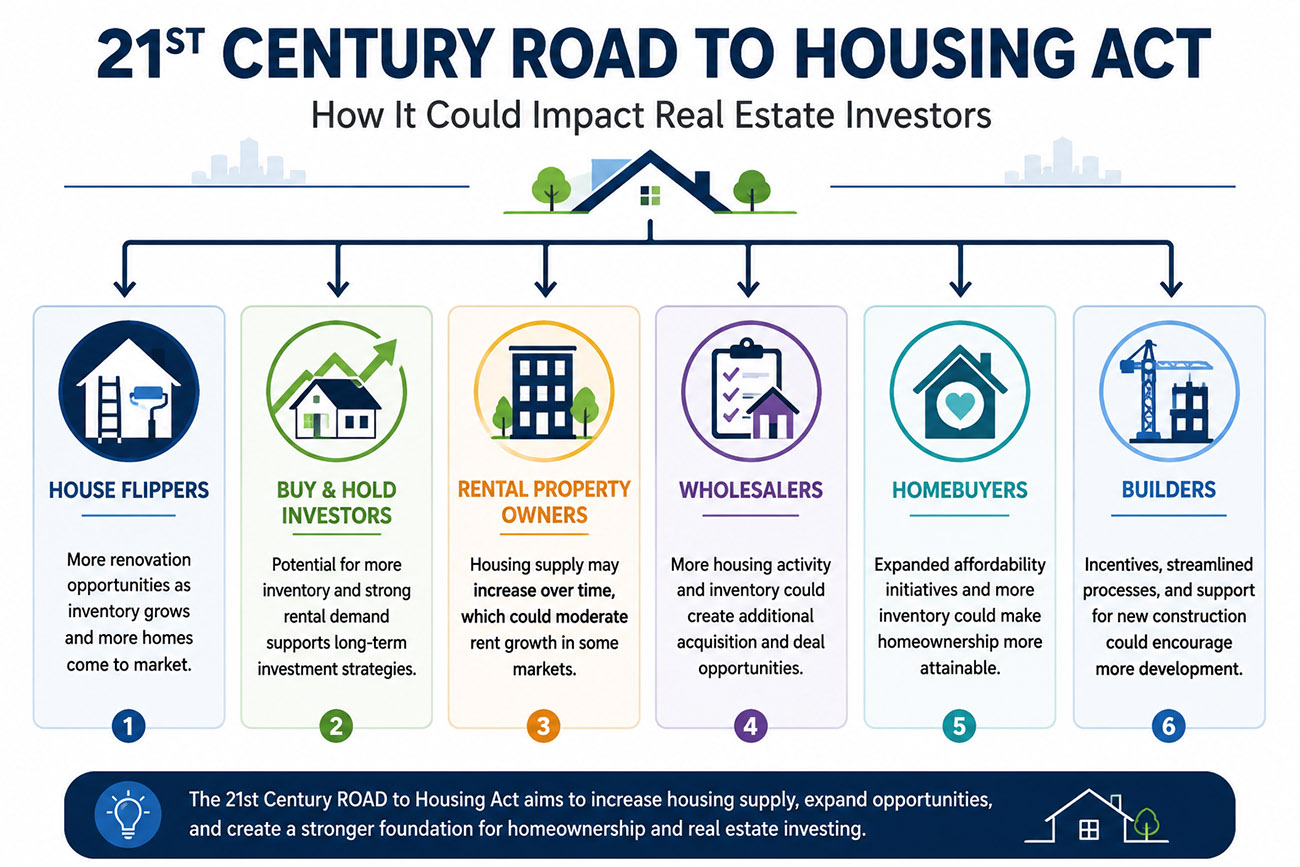
House Flippers
If the bill succeeds in encouraging more residential construction and rehabilitation, flippers could eventually benefit from increased renovation opportunities and healthier transaction volume. At the same time, additional housing supply may reduce the rapid price appreciation seen in many markets over the past several years.
Buy-and-Hold Investors
Long-term investors should continue focusing on local market fundamentals. Even if housing supply increases nationally, many markets will continue to experience strong rental demand due to affordability challenges and limited inventory.
Rental Property Owners
The legislation is intended to expand housing options, but any impact on rents is expected to occur gradually. New construction takes years, and housing demand continues to outpace supply in many parts of the country.
Homebuyers
First-time buyers may benefit from expanded financing programs, increased housing inventory, and additional support for affordable housing initiatives. However, affordability will still depend heavily on mortgage rates, local inventory, and regional economic conditions.
Institutional Investors
One of the bill’s most discussed provisions would restrict future purchases of single-family homes by large institutional investors once they exceed a defined ownership threshold. The provision is aimed at addressing concerns that large corporate landlords have reduced opportunities for owner-occupants in some markets.
For the vast majority of FortuneBuilders readers—individual investors, small partnerships, and local operators—this provision is unlikely to have a direct impact.
Why This Won’t Solve the Housing Crisis Overnight
Housing shortages developed over many years and won’t disappear quickly.
Even with new federal policies, builders continue to face challenges including:
- High construction costs
- Labor shortages
- Local zoning restrictions
- Financing costs
- Elevated mortgage interest rates
Most housing experts agree that increasing supply is an important step, but meaningful improvements in affordability will take time as new homes move through planning, permitting, and construction.
Potential Impact by Investor Type
| If You Are… | Potential Impact |
|---|---|
| House Flipper | More renovation opportunities over time as inventory grows. |
| Buy-and-Hold Investor | Long-term market fundamentals remain more important than federal policy changes. |
| Rental Property Owner | Rent growth may moderate in some markets if supply increases. |
| Wholesaler | Additional housing activity could create more acquisition opportunities. |
| Homebuyer | Potential for more inventory and expanded financing options. |
| Builder | Streamlined regulations and housing incentives may support additional development. |
Final Thoughts
The 21st Century ROAD to Housing Act represents one of the most significant bipartisan housing reform efforts in decades. While many of its provisions are designed to increase housing supply and improve affordability, investors shouldn’t expect immediate changes in local markets.
Instead, view the legislation as one piece of a much larger housing puzzle. Interest rates, local inventory, employment, population growth, and neighborhood demand will continue to play a much larger role in determining investment opportunities.
As always, successful real estate investors stay informed, adapt to changing market conditions, and focus on long-term fundamentals rather than short-term headlines.
Ready to start taking advantage of the current opportunities in the real estate market?
Click the banner below to take a 90-minute online training class and get started learning how to invest in today’s real estate market!


Article Sources
- Congress.gov – Legislative actions and bill text
- U.S. Senate Committee on Banking, Housing, and Urban Affairs – 21st Century ROAD to Housing Act section-by-section summary
- Bipartisan Policy Center – Inside the Deal: What’s in the Final 21st Century ROAD to Housing Act?
- Reuters – Coverage of Senate passage and key housing provisions
- MarketWatch – Analysis of the bill’s legislative status and housing market implications

